Muskan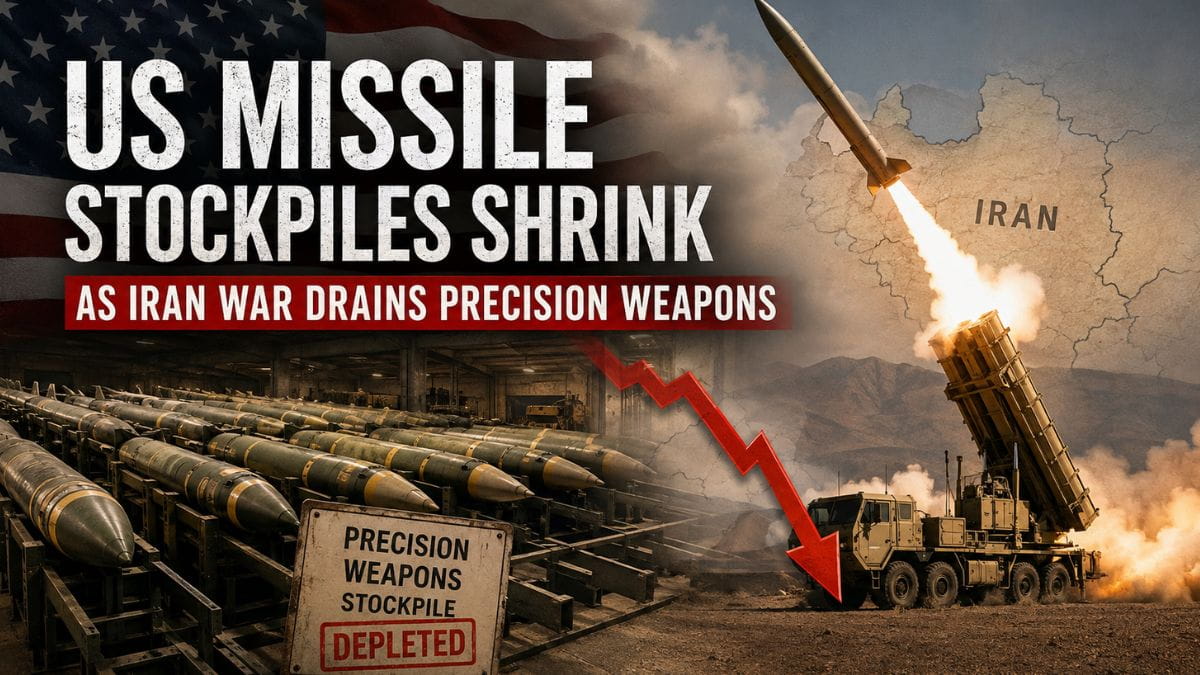
US Missile -The ongoing Iran war is said to have decimated America’s stockpile of long-range, precision missiles.
Officials familiar with the situation said that several of the service had already fired off most of their available supply of Army Tactical Missile Systems (ATACMS) or Precision Strike Missiles (PrSM) during the fighting.
In addition, the current drawdown of America’s military capabilities in the region has raised new questions in Washington about the capacity to project power in the future if another large-scale conflict breaks out.
Though the White House is quick to note that America still has one of the largest and most potent military resources in the world, defense experts warn that the rapidity with which the United States has deployed missiles during the Iran war is damaging to its strategic military position.
Iran War Reportedly Depletes Key Precision Missile Supplies
The main concern is related to the Pentagon’s strategic assets, including two key long-range conventional missiles:
Army Tactical Missile System (ATACMS)
Precision Strike Missile (PrSM)
They enable the United States to strike targets beyond the reach of any other military asset possessed by the Pentagon, hitting them from a distance and eliminating the need for planes and pilots to penetrate enemy air defenses. People close to the discussion said that almost all of the ATACMS and PrSM missiles the Pentagon had on hand for the conflict with Iran have been used in the fighting. “There were a limited number to begin with,” said one defense analyst. “And we’re already gone through most of them.” The PrSM is the successor to the ATACMS, and it is set to replace the existing inventory.
Pentagon Faces Questions Over Long-Term Readiness
Military planners are said to be concerned that current levels of stockpiles may hinder the US in case of a crisis.
Long-range precision-guided missiles are central to the US ability to conduct prompt retaliatory attacks while avoiding the heavily defended airspace of a potential opponent.
Their value was underscored by Defense officials, who argued that they would be essential in case of a conflict with China and other powers that can shoot down US planes.
At the same time the Pentagon says that the US military remains prepared.
White House Says US Arsenal Remains Strong
In response to reports of depleted stores, President Donald Trump asserted that America has more missiles than anyone else.
The administration pointed out that America’s defense companies are ramping up production and boosting output of some critically needed weaponry.
Besides, Pentagon spokesperson Sean Parnell noted that the U.S. military is capable of executing the President’s orders at any time and place.
Administration officials argued that production could offset the heavy spending on the Iran war.
Production Is Increasing, but Demand Remains High
Defense industry analysts are confident that the production of several missile systems and artillery ammunition has ramped up exponentially within the last few years.
At the same time, experts note that the production of precision-guided munitions requires a substantial amount of time to produce and utilize.
Defense producers are also working to meet the demand for production while rebuilding stockpile reserves after months of intense combat use.
Other US Missile Inventories Also Under Pressure
The reported shortfall involves more than just Army weapons.
Defense officials have said that large numbers of other sophisticated missiles have also been used in the current fighting, including:
Tomahawk cruise missiles
Patriot air-defense interceptors
THAAD missile-defense interceptors
All are critical weapons in the Pentagon’s arsenal.
Defense analysts say that the United States needs to maintain its military readiness around the world by keeping a surplus of missiles of different types.
Why Precision Missiles Matter
What advantages do modern, precision-guided missiles offer? Give examples
Long-range,
reduce the risk to the pilot,
accuracy,
quick response to strategic targets,
and
better than conventional ones when it comes to hitting hardened sites
Therefore, because of their many advantages, precision-guided missiles have become a mainstay of modern armed forces.
The Iran war demonstrated both the effectiveness of these weapons, and the challenge of maintaining a steady supply of them during prolonged combat.
What Happens Next?
As the Iran war rages on, focus is likely to remain on the ability of the United States to rapidly replenish its missile stockpiles in order to meet demands from other potential conflicts.
While defense contractors are already ramping up production, analysts remain cautious regarding the amount of time it will take to significantly refill the arsenals with cutting edge technology.
The discussion about the preparedness of the United States is therefore likely to continue as officials balance the demand for current operations with future needs.