Muskan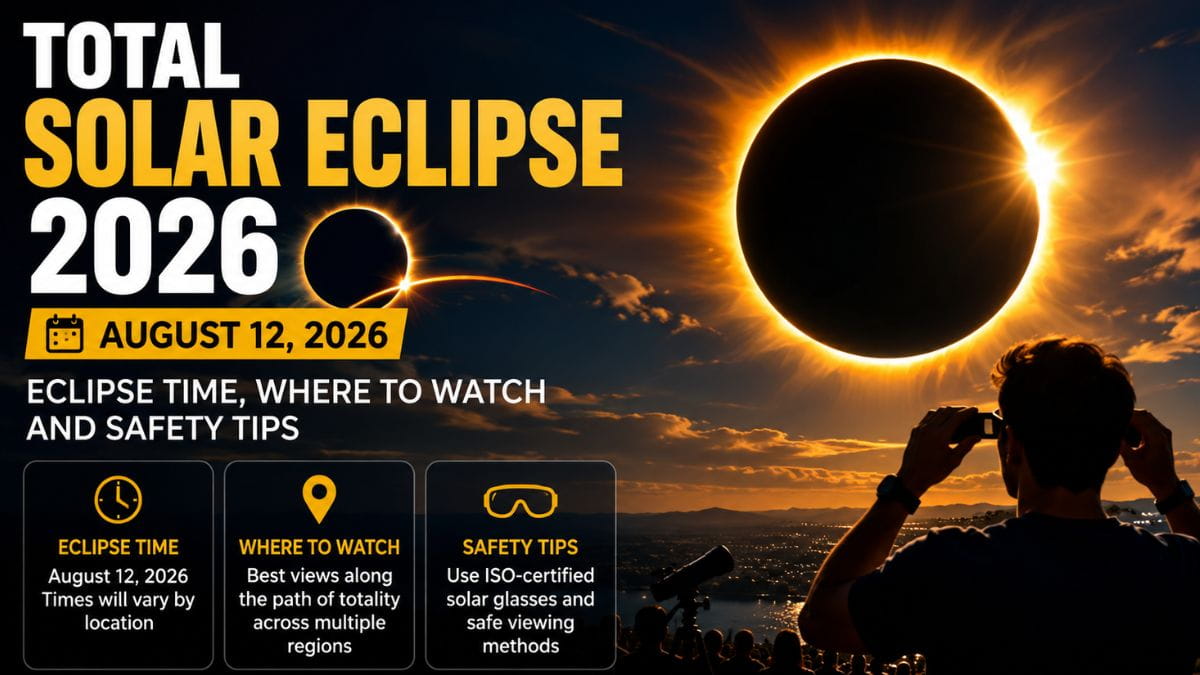
The Total Solar Eclipse 2026 is set to become one of the most remarkable astronomical events this year. On August 12, the Moon will pass between the Earth and the Sun, temporarily blocking the sunlight and making it visible to observers in the path of the eclipse.
The total solar eclipse occurs when the Moon is precisely positioned between the Earth and the Sun, and its shadow falls on the surface of the planet. People who are located within the shadow path can witness this spectacular phenomenon, as the Sun will be completely obscured by the Moon for a short period of time.
The solar eclipse will be visible in the form of a partial eclipse in most of the Northern Hemisphere, while the places located at the path of the total eclipse will see the Sun fully covered.
Where Will the 2026 Total Solar Eclipse Be Visible?
The path of the 2026 solar eclipse will extend across a number of northern countries before reaching Europe.
The places that will be able to see the total solar eclipse are northern Russia, Greenland, Iceland, northern Spain, and the small region in Portugal. These areas will be the most rewarding ones for the observers, as they will be able to see the entire sequence of the total solar eclipse.
Iceland and Spain, in particular, are expected to host a large number of tourists, as the solar eclipse will occur near sunset in these countries. This will result in an unusual sight, as the obscured Sun will be seen close to the horizon.
Meanwhile, the regions that are outside the path of the total eclipse will still be able to see a partial eclipse. The solar eclipse of 2026 will be visible in most of Europe, as well as parts of North America and northwest Africa, in the form of a partial eclipse.
What Time Is the August 12 Solar Eclipse?
The solar eclipse time will vary depending on the location of the observer.
The eclipse will be visible in the form of a partial eclipse for several hours, as the Moon will slowly cover and then expose the Sun. The time when the total eclipse will be visible is much shorter, as the Sun will only be fully obscured for a short period.
The most interesting time for the observers will be when the Moon passes in front of the Sun, gradually covering it. The duration of this period, as well as the time when the total eclipse will begin and end, depends on the location of the observer.
It is advisable to consult an eclipse timetable to determine the exact solar eclipse time for a particular region.
What Will Happen During the Eclipse?
During the total solar eclipse, the daytime sky will become dramatically dark, as the Moon will block the sunlight.
As the Moon progresses in front of the Sun, the area around it will become gradually darker, and the temperature will begin to drop. In addition, it will be possible to see some stars and planets that are usually not visible during the day.
During the total eclipse, the corona of the Sun will become visible, as the bright surface of our star will be covered by the Moon. Moreover, just before and after the total eclipse, there is a possibility to see some fascinating phenomena such as the diamond ring and Baily’s beads.
Will the Solar Eclipse Be Visible in the US?
The solar eclipse will be partially visible in most of the United States, as the majority of the country is located outside the path of the total eclipse.
The portion of the Sun that will be covered depends on the location of the observer. Thus, the northern regions of the United States will be able to see a bigger part of the Sun than the southern ones.
In addition to the United States, Canada will also be able to see the partial eclipse, while most of Europe will be able to witness a much more significant solar eclipse.
How to Watch the Eclipse Safely
Looking at the Sun without proper equipment can be very dangerous for the eyes.
Therefore, it is important to use special solar eclipse glasses when watching the partial phases of the eclipse. In addition, it is not recommended to use regular sunglasses, as they do not provide the necessary level of eye protection.
It is also dangerous to look at the Sun through cameras, telescopes, or binoculars without a proper solar filter. Observers within the path of the total eclipse should only remove their protective glasses when the Sun is completely covered by the Moon. Moreover, it is important to put them back on as soon as the sunlight becomes visible again.
How to Watch the Eclipse Online
Since the solar eclipse will only be visible from certain regions, it is a good idea to watch it on TV or online. The live stream of the 2026 solar eclipse will be broadcast from the path of the total eclipse, providing an unparalleled view of the event.
This way, the people who are unable to reach the regions where the eclipse is visible will also be able to enjoy the spectacle.
In particular, online streaming will be a convenient way for people from the United States to watch the total solar eclipse, as it will only be partially visible on their territory.
What Comes After the 2026 Eclipse?
The solar eclipse of 2026 will not be the last one, as another total solar eclipse will occur next year on August 2, 2027.
This year’s eclipse will be visible from most of southern Europe, northwest Africa, and the Middle East. In particular, the regions located near the path of the total eclipse will be able to witness a long eclipse, as the duration of the total phase will be the longest in recent times. Thus, a large number of tourists are expected to visit these places.
For now, it is worth paying attention to the solar eclipse of 2026, which will be visible from some of the most beautiful places on Earth.